
Single-Man Bucket or Two-Man Bucket?
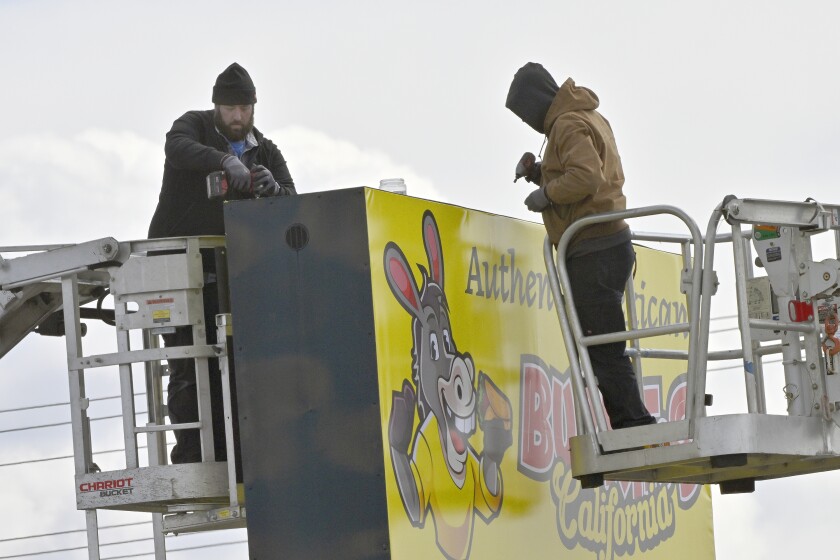 Most aerial lift manufacturers produce both single-man and two-man buckets. We don’t. At Van Ladder, we only produce a single-man bucket, but we design accessories that in many cases make a two-man bucket unnecessary (at least for sign work). So, when people ask if we have a two-man bucket option, their question inevitably leads to a discussion about what the two people are doing when they’re up in the air. More precisely, the person who’s not operating the lift—what’s he/she doing?
For example, we once observed a job site where two guys were hanging a paper template marking installation holes for 5’ channel letters spelling the word “KOHL’S”. The men were using an 85’ crane truck with a two-man bucket. In this case, there wasn’t a single component of the sign that weighed more than fifty pounds, but both the pattern and the individual channel letters were too clumsy for one installer to hang by himself, hence the two-man bucket. The helper’s job was to hold the pattern in place while the other guy taped the paper to the wall. Same thing for the individual channel letters—the helper held them while the other guy installed the fasteners. My partner, Dave, looked at me while the pattern went up, and said, “That’s a lot of truck to hang paper!”
In the above case, a Van Ladder bucket truck with the Chariot Bucket would have been perfect. It not only has plenty of working height and side reach to install the entire set of channel letters from one parking position, but it also has bucket accessories that accomplish what the second person would be doing in a two-man bucket—namely holding something. Our pattern arms hold paper templates securely while the tape is being applied, and our sign platform and clamps hold the 5’ channel letters in place, so the installer has his/her hands free to work with tools. This frees the second person to work on the ground or behind the wall, making the 2-person team almost twice as efficient. Add to that the fact that a Van Ladder is half the cost of an 85’ crane truck with a two-man bucket, and it’s hard to make the case for not using a single-man lift with the proper sign installation accessories.
I’ve also observed a case when a Van Ladder could perform the work but couldn’t match the efficiency of a two-man bucket. In this instance, the company was installing pole light fixtures in a gigantic parking lot. Each 40’ pole had three fixtures at the top. The old fixtures were each 75 lbs. and the new LED fixtures were 25 lbs. Because the two-man bucket had a 500 lb. platform capacity and additional room in the bucket, a single installer was able to re-lamp an entire pole without having to return to the ground. With the Van Ladder, each pole would have required two trips up and down. That re-laming job occurred at night, when the parking lot was empty. So, the installers were looking for every efficiency they could find to finish the job in the limited hours available to them. In that case, the two-man bucket made perfect sense, even though the truck was more expensive.
The key is finding the most efficient aerial equipment for most of your work, especially if you only have one truck. If you have multiple aerial trucks, a good exercise is to ask which jobs you currently do are the least efficient. Then ask why. Are you having a hard time setting up the truck in cramped parking areas? Do you lack the reach to accomplish the job in a single set-up? Are you lacking accessories to simplify your installations? Are you short of onboard storage for tools, inventory, and equipment? Would more capacity for craning help? Do you need more working height? What piece of equipment would bring the biggest benefit in terms of diversifying your fleet?
Jason Ricketts, owner of Airport View Signs in Frederick, Maryland, owned two bucket trucks. One was an Elliot M43R (with a two-man bucket), and the other was a single man fiberglass bucket. Jason was happy with his Elliot, but he wanted to replace his single-man bucket with a truck having both a smaller chassis and more side reach. Van Ladder was the only option that checked both boxes. Here’s an excerpt from my interview with Jason:
Me: “How has the sign industry changed in the last twenty-five years?”
Jason: “The biggest change in the sign business has been the conversion from Neon to LED, making signs a whole lot easier to install, a lot less time, a lot lighter, and easier to build.”
Me: “What led you to Van Ladder?”
Jason: “I had an articulating one-man bucket truck, and it didn’t have the sideways reach that a lot of times this business requires because of sidewalks and parking spaces and different things. So, I started looking around for a lighter weight and smaller vehicle to get around in the big cities that had that kind of reach, and the Van Ladder was really the only one. And it’s proven to be exactly what I thought it was going to be. It’s got that good sideways reach, because a lot of times you’ve got to reach twenty-five or thirty feet to the side, and it can do that. And having the pivoting bracket on the front (rotating material handling system) makes it ever better, so you can get squared up. I can’t think of a situation that we’ve been in that we haven’t been able to utilize it. Obviously, the only thing would be the weight restrictions, but like I said before, we don’t really handle stuff that’s that heavy anymore.”
Me: “Tell me about your other truck.”
Jason: “The other truck is an Elliot M43R. They both have their place in the business. With the Elliot being a crane, the other option is when signs are that heavy, we crane it in place and use the Van Ladder to attach it. A few months ago, we did a big pylon in Glen Burnie where we used the crane to pick the stuff up and the Van Ladder to attach it all. It was a big electronic message board, and it made it real nice.”
Me: “So, if you looked at your whole portfolio of business today with the lighter weight signs, how much as a percentage could the Van Ladder tackle?”
Jason: “I would say in this business that I have—the work that we do—it’s probably about 90%. There’s not a whole lot that we do that it can’t do. Banners, channel letters, putting up paper patterns for Gemini letters or whatever, it works great. If I had to start from scratch, knowing that I was going to do installations, I would definitely buy the Van Ladder for a couple of reasons. One, it’s easy to use. It’s more compact to get around town, and probably one of the biggest things for us is that you can put everything inside of it, and you don’t have to worry about strapping it all down, or the potential of it falling off, or getting damage on the road, because there is a lot of cargo space and there’s plenty of places for all your tools. And it opens (the possibilities of) the people that can operate it. They can drive it because it’s a smaller vehicle. The bigger bucket trucks, you may need a CDL to drive. You can even use it as a cargo van, you know, just to go letter some windows. You don’t always have to use the ladder (aerial lift) portion of it. So, you wouldn’t need to buy a second vehicle to do ground-type stuff. You can drive it downtown and park it in a parking spot and be comfortable with it because it’s not much bigger than a Transit Van.”
As you can see, Jason feels good about the diversification of his fleet, even with only two trucks. He has an Elliot crane (with a two-man basket) that can lift a couple thousand lbs. to tackle the big jobs, and he has a fully stocked Van Ladder to handle the jobs weighing less than 200 lbs., which these days covers most of his work. And it’s nice that the lion’s share of the miles accrues to the less expensive vehicle. That stretches the life of the crane, which is a more costly truck to replace.

