Bucket Truck Accessories for the Sign Industry

If you go to any sign manufacturing enterprise and look at the machinery inside the shop, you’ll find highly specialized equipment for printing, cutting, and forming signs. Wouldn’t it make sense, then, that the equipment used for installing signs should be highly specialized, too?

New generation signs are shockingly lightweight, but still clumsy to hold. Most signs today weigh less than 200 lbs., so from a weight standpoint, they certainly don’t require a crane. What they do require, though, is specialized material-handling accessories. Without these specialized fixtures, you’re probably stuck using a larger truck with a two-man basket, simply to have one person to hold the sign while the other is taping, leveling, drilling, etc. From an efficiency standpoint, this leaves a lot to be desired.

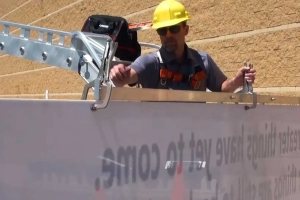
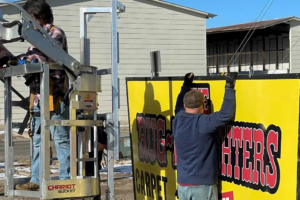
At Van Ladder, we recognized that the sign industry wasn’t being served with installation equipment specifically designed for today’s reality. So, we set out to create an aerial workshop with an arsenal of tools to free an installer’s hands, allowing them to perform almost any kind of sign installation (under 200 lbs.) safely and efficiently without a second person in the bucket. Here’s a summary of our specialized tools.
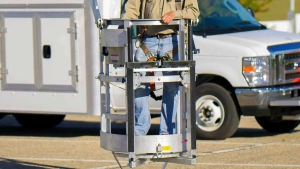
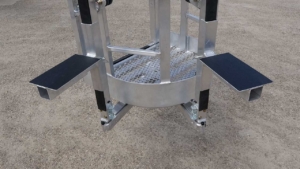
The Chariot Bucket

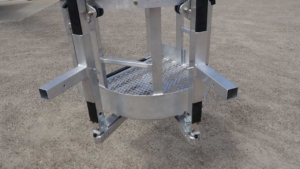
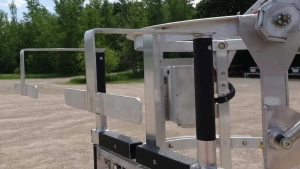
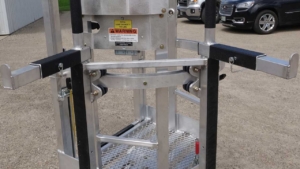
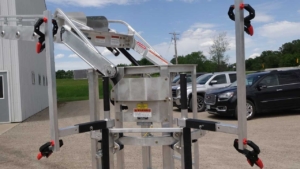
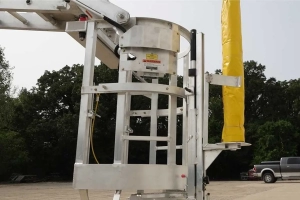
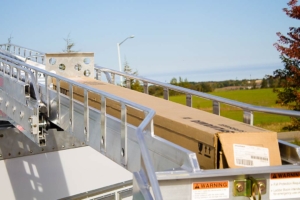
Much like a Roman Chariot, the Chariot Bucket has a rounded front. Permanently attached to the bucket is a rotating material-handling system, giving installers 140 degrees of rotation. This feature not only allows signage to be attached to the bucket, but it also allows the installer to square-up the sign to a wall regardless of how the truck is parked. The Chariot has retractable upper and lower forks for holding raceway signs, cabinets, or large channel letters.

Sign Platform and Pads

One consequence of signs becoming lighter is that they’ve lost much of their structural integrity prior to being attached to a wall. For this reason, it’s often easier to support the sign from beneath than to hang it from above. That’s why we’ve designed a non-slip platform that sits on the forks. There are cases, however, when the platform doesn’t work because the sign isn’t flat on the bottom. For those circumstances, we’ve also designed non-slip pads.

Attachable Mid-forks

It’s not unusual for buildings to have an awning below the sign and an overhang above it. What do you do when the lower forks are hindered by an awning and the upper forks are hindered by an overhang? You attach the mid-forks, onto which the platform or pads can be affixed.

Securement Clamps

It’s nice having the weight of the sign sitting on the forks, but how do you keep the sign from falling off the forks if there’s a gust of wind? That’s what our securement clamps are for. When installing a cabinet sign, the two clamps simply fit over the top and keep the cabinet from falling forward. For channel letters on a raceway, the clamps fit over the letters, exposing the raceway to the wall.

Upper Fork Extensions

These extensions can be handy when removing an old sign from a wall. Sometimes, after lag bolts are removed, the sign seems to be held in place with nothing but caulk. The fork extensions have steel tabs at the end, which can be slid behind the sign while it’s being pried away from the wall. This helps ensure that the sign won’t fall to the ground while you’re operating the pry bar.

Face Bar

The old style pan faces behaved quite well sitting on the forks, but this isn’t true of flex faces. So, the face bar attaches to the Chariot Bucket and gives you an 8’ bar on which you can clamp a flex face. It works well on faces up to 12’ long x 5’ wide. And, because the bar is attached to the rotating material-handling system, it’s easy to line up the face with the slots in the sign. Then, slide the face in, removing clamps as you go.

Pattern Arms

It might take four arms to attach a paper template to a wall, but it shouldn’t take two people. Adjustable up and down and from side to side, the pattern arms hold the template in position, allowing you the use of your hands for levelling and taping.

Banner Spindle

The banner spindle is like a giant tape dispenser, allowing the installer to have both hands free for leveling the banner and installing the fasteners.

Jib Attachment

For signs that aren’t designed to be supported from the bottom, or for cabinets that are too tall to rest on the lower forks, the jib attachment is the perfect accessory. It gives you an elevated lifting eye at approximately the height of the installer’s face, allowing the sign to be hung from above rather than supported from beneath.

Project Bag

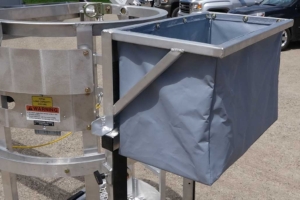
When you have a bunch of 12” dimensional letters to install and you don’t want them sitting near your feet in the bucket, or when you’re doing an LED retrofit and you want a handy place to store your lights, tools, and cleaning supplies, the project bag will become your best friend. The project bag has an aluminum frame, canvas sides, and a high-density poly bottom. The wonderful thing is that it rotates around the bucket on the Chariot’s material-handling system, so it’s never in your way.

Tool Tray

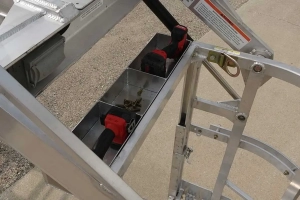
The tool tray is mounted onto the Chariot Bucket directly behind the installer. It has three compartments, two with large holes for holding your drills, and a center compartment for fasteners.

Bulb Holder

This tool provides a hard-stop for holding fluorescent bulbs or LED light sticks in the protected area between the rails of the fly ladder. Since the bulb holder clamps to a rung, it can be moved up or down the fly ladder to accommodate any size bulb or LED light stick.

Below-the-Bucket Lifting Eye & Remote Control

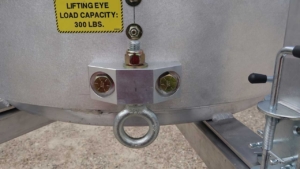
If you want to leave the bucket unmanned for craning, we’ve installed a lifting eye on the underside of the Chariot Bucket. Our corded remote has plenty of length for the operator to move around to see what he/she is doing.

Obviously, with our 400 lb. bucket capacity (including the installer), the Chariot can’t hoist the big signs. That’s what the big trucks are for. But even for those jobs, the Chariot makes a great helper rig. Sign installers have a hard job, but having the right tools can make it a whole lot easier.