
How Modern Sign Companies Benefit from a Smaller Install Truck
 For decades, the sign industry has relied on large crane trucks to get installations done. And for heavy lifts, tall pylons, and large-scale projects, those trucks still absolutely have their place.
But according to Chilton LED owner Chris Chilton, the industry is changing — and the companies adapting the fastest are the ones adding smaller, more agile service trucks to their fleet.
At their shop in Dundee, Florida, Chris had grown used to performing installations with a large crane truck. But after buying a Chariot bucket truck, they discovered something surprising:
The smaller truck wasn’t replacing their big truck.
It was solving problems the big truck couldn’t.
The Problem with Traditional Sign Trucks
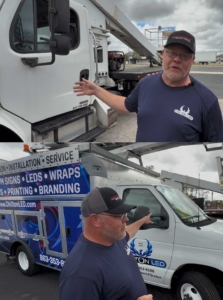
To show me how large and loud his two-man bucket truck is, Chris started the conversation standing beside his running 2004 diesel-powered sign truck equipped with a two-man bucket. It didn’t take him long to shut it down so we could hear each other.
Like many companies in the industry, Chilton Signs originally bought it out of necessity.
After a hurricane created a shortage of equipment in Florida, the truck was one of the only sign trucks available. And to be fair, Chris says the truck paid for itself quickly.
But daily operation became another story.
Before the truck can even begin working, stabilizers need to be deployed, hydraulics engaged, and the entire site carefully managed.
“It’s all logistics,” Chris explains. “Moving people out of the way, waiting 20 to 30 minutes, setting up cones, putting feet down. It’s a lot more than what people think.”
That setup process creates delays on virtually every job.
And when you’re doing multiple installations, surveys, service calls, or maintenance jobs every day, those delays compound quickly.
Bigger Trucks Create Bigger Costs
And the expenses go far beyond setup time.
Chris details the reality many sign companies know all too well:
- Diesel fuel costs
- Constant greasing and maintenance
- Expensive OEM replacement parts
- Hydraulic repairs
- Electrical issues
- Long downtime waiting for specialty components
- Difficult operator training
- CDL-related limitations
- Safety concerns with older equipment
At one point, Chilton Signs spent roughly $20,000 rehabilitating their older truck’s hydraulics and electrical systems just to keep it operational.
Even then, replacement controllers could cost $1,000–$1,500 each and take weeks to source.
Meanwhile, the Chariot Bucket Truck operates on a standard gas platform, uses sealed systems, and dramatically reduces operating costs.
“The Van Ladder I’ll fill up once a week and we’ll get four to five hundred miles from it,” Chris says. His big truck uses that much fuel in a day on a big job because the truck is running when the lift is in use.
For companies running lean operations, those savings matter.
Why Smaller Trucks Win More Jobs
The biggest advantage of a smaller service truck isn’t just lower cost.
It’s flexibility.
The Chilton team repeatedly describes how the Chariot allows them to complete jobs that would otherwise require:
- lane closures
- traffic cones
- ladders (inaccessible areas for the bigger truck)
- additional manpower
- or significantly more setup time
Dean explains how simple sign installations became dramatically faster once they stopped relying on ladders.
Why?
Because he wasn’t constantly climbing down, moving ladders, repositioning equipment, or managing extension cords.
The truck let him stay focused on the installation.
Tight Spaces Are the New Normal
Modern sign work increasingly happens in crowded commercial environments:
- gas stations
- strip malls
- shopping centers
- drive-thrus
- tight parking lots
- downtown retail stores
That’s where smaller trucks separate themselves from traditional equipment.
While setting up for a job, Dean points to the tight installation area and laughs about what bringing the large truck would have required.
“We would have to shut down one of the lanes, get the traffic cones… oh my gosh.”
Instead, the smaller truck maneuvered easily into a tight parking area in front of the store while the crew completed a sign face replacement with minimal disruption.
For many service calls and small installs, the large truck simply becomes overkill.
The Hidden Advantage: Easier Training
One of the most overlooked problems in the sign industry today is labor.
Experienced installers are harder to find than ever.
Chris speaks candidly about the challenge many shop owners face:
“Before COVID, I could still find electricians and multi-skilled guys. Now pickin’s are kind of slim.”
Large manual-transmission diesel trucks with complicated hydraulic systems require extensive operator training.
The Chariot changed that completely.
Chris describes it as:
- easier to train on
- safer to operate
- more intuitive for younger employees
- and far less intimidating
Dean, who had only been driving for about a year, was already comfortably maneuvering the truck and handling the truck’s maintenance himself.
That matters for growing companies trying to scale crews efficiently.
Safety Isn’t Optional
Safety came up repeatedly throughout the interview.
Traditional bucket trucks rely heavily on proper stabilizer setup and operator experience. Mistakes can be catastrophic.
Chris shared a story about a former employee using the older truck improperly for tree work at home. The stabilizers weren’t set correctly in sandy soil, causing the truck to tip into the employee’s house.
The Van Ladder system incorporates built-in safeguards:
- parking brake interlocks
- foot-switch controls
- enclosed systems
- smoother bucket movement
- rounded edges
- remote operation
- simplified controls
Chris repeatedly emphasized how much more confidence he has putting employees into the newer platform.
“This is the 21st century sign truck,” he says.
The Best Setup Isn’t Either-Or
What makes the Chilton Signs story especially interesting is that they’re not arguing against big trucks.
In fact, they still rely on theirs for heavy lifting and large installations.
The real breakthrough came when they paired both systems together.
While Chris and Will worked from the larger two-man bucket installing channel letters, Dean simultaneously handled stud-mounted signs using the smaller service truck.
Two trucks.
Two crews.
Two completely different applications at the same job site happening at the same time.
That’s where efficiency multiplies.
“The two of these trucks together are a super power team,” Chris says.
Why More Sign Companies Are Rethinking Their Fleet
For years, sign companies assumed growth meant buying bigger and bigger equipment.
But companies like Chilton LED are proving something different:
Sometimes the smartest investment isn’t replacing your big truck.
It’s adding the right smaller truck beside it.
Because in today’s sign industry, speed, flexibility, maneuverability, ease of training, and lower operating costs are bigger factors than lifting capacity on many (if not most) jobs.
So a smaller truck is often the right tool for the job.
