
Built by Hand, Sustained by Trust:
Phillips Signs and a Long-Term Partnership with Van Ladder Bucket Trucks
 When Ben Phillips looks back on more than four decades in the sign industry, what amazes him most isn’t a single job, a single piece of equipment, or even the scale of the operation Phillips Signs has become.
It’s the way everything connects.
The people.
The decisions—good and bad.
The willingness to learn, invest, and adapt.
And the relationships that prove their worth not once, but over time.
From Truck Doors to a Trade
Ben’s entry into the sign business didn’t come from a grand plan. It came from curiosity.
In the late 1970s, Ben was working for his grandfather’s construction company—something he’d done since he was 13 years old. While unloading truckloads of metal buildings, his attention kept drifting to the hand-lettered logos and names on the truck doors.
“I’d look at the lettering and think, I could do that.”
So he tried.
He bought brushes, paint, and lettering books and started practicing. What began as dabbling quickly became a reputation. Ben was good—really good—at hand lettering and pinstriping. It became his passion, and eventually, his calling.
He left the construction company and went all in.
In the early days, Phillips Signs didn’t have a shop, a lift, or a fleet. Ben worked out of the back of a Ford pickup with a box of brushes and paint, setting up at truck stops or wherever someone would pull a vehicle in. Everything was done by hand. That was just how it worked back then.
As his customer base grew, so did the scope of his work. Hand-painted signs led to bigger projects, and bigger projects demanded more space. Ben built a small shop behind his house about 14 miles from where Phillips Signs operates today.
It was the first of many growth steps—and none of them happened alone.
Investing in People First
One of the defining traits of Phillips Signs has always been Ben’s approach to people.
He credits much of his own success to others who were willing to share what they knew. As a result, he never hesitated to do the same.
A young kid walking home from school used to stop by Ben’s shop just to watch him work. Ben noticed he had real talent for hand lettering. That kid became Phillips Signs’ first employee—and decades later, he’s still there.
“He’s almost like a son to me now,” Ben says.
That philosophy never changed. When customers began asking for illuminated signs, channel letters, and things Ben didn’t yet know how to do, his answer was never no.
“I don’t do that,” he’d say, “but I’ll figure out a way.”
He hired people who had the right skillsets and were willing to grow alongside the business. Phillips Signs didn’t just add capabilities—it earned them.
Growth Fueled by Opportunity and Grit
In 1991, Phillips Signs reached a turning point.
Ben had little money but a lot of momentum. A realtor friend sold him an acre of land along a major highway for almost nothing—property no one else wanted. Ben convinced a bank to finance a modest building, and suddenly Phillips Signs had visibility.
From there, the growth accelerated.
A small bank client with one branch expanded to ten—and Phillips Signs grew with them. Illuminated awnings became popular in the late 1990s, and Ben didn’t hesitate to jump in. At first, they purchased awnings from a supplier in Florida. Then they studied the products, learned the systems, and began doing them better themselves.
That willingness to learn paid off when Phillips Signs landed a massive outlet mall project—thousands of feet of lighted fascia, awnings, towers, and flex-face signage.
Ben admits he didn’t know exactly how they were going to pull it off.
So they built more shop space. Literally.
One summer, three guys (one of whom as Ben) added 100 feet onto the building—pouring concrete, running electrical—just to get the job done.
“That’s how we’ve always operated,” Ben says. “You do what you need to do.”
Equipment Is Not a Luxury—It’s a Responsibility
As Phillips Signs grew, Ben became firm in one belief: you must invest in equipment.
“I’m amazed how many competitors don’t,” he says. “Equipment wears out. Technology changes. If you don’t stay on the cutting edge, you’re getting left behind. One hundred percent.”
Early on, that meant buying used equipment—because that’s all he could afford. It also meant learning quickly what worked and what didn’t.
In the early ’90s, before Phillips Signs owned a proper crane truck, Ben relied on a 1974 all-electric Garland crane.
“It looked like a fishing rod every time you used it,” he laughs.
We installed a lot of signs with it—but it was finicky, battery-dependent, and constantly being tinkered with. That experience left Ben skeptical of electric lift systems for years.
Eventually, he purchased his first true sign crane: a fully hydraulic 1995 Elliott. He still owns it today. It’s reliable, familiar, and proven.
For decades, hydraulic bucket trucks were all Ben trusted.
Enter Van Ladder—With Some Skepticism
About five years ago, Phillips Signs needed a new service truck—something with enclosed storage and a reliable lift.
Ben’s son, an electrical engineer who also handles maintenance on the fleet, suggested looking at Van Ladder.
Ben’s reaction was immediate.
“It’s all electric. I don’t think it’s for us.”
His son saw it differently. From a maintenance perspective, the simplicity was appealing. No hydraulic systems. No constant engine idling. Less wear on the powertrain. Fewer long-term headaches.
Eventually, Ben agreed to try one.
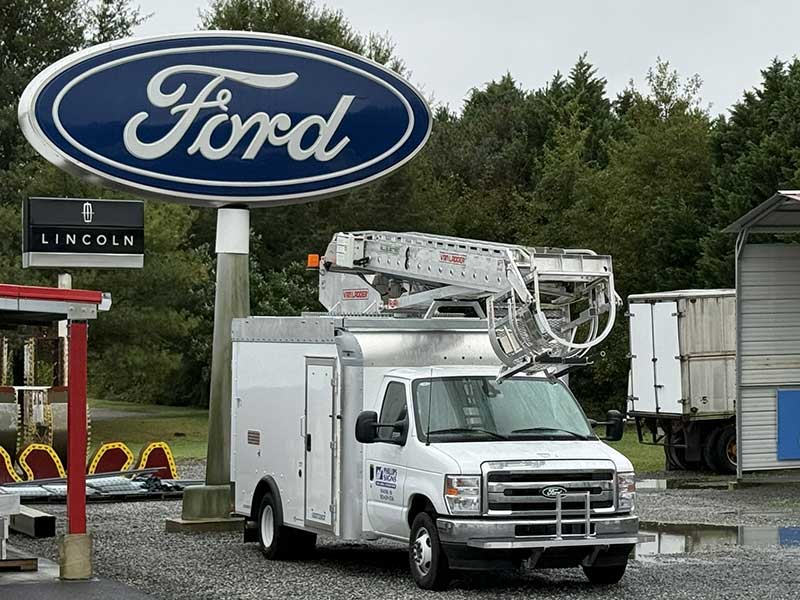
They ordered a Van Ladder on a Workport body, and right away, it changed how service work was done. The enclosed storage, side access doors, and layout allowed the crew to stock everything they needed—especially important before LED retrofits reduced weight and components.
Most importantly, the truck just worked.
“It was maintenance-free,” Ben says. “The batteries weren’t an issue. The truck charges them. You take care of them, and that truck works every day.”
They ran it for five to six years, putting heavy mileage on it. When it came time to replace it, his son suggested another Van Ladder.
“I see no reason not to,” Ben told his son. “It’s been everything they said it would be—and then some.”
Innovation That Actually Matters
When Phillips Signs began speccing their second Van Ladder, Ben noticed something else.
Van Ladder hadn’t stood still.
The Chariot Bucket.
New accessories for installation and service.
Thoughtful, practical improvements that made real-world work easier and safer.
“This is common-sense stuff,” Ben says. “The kind of thing that makes a guy who uses the truck every day shake his head and say, That’s a good idea.”
For Ben, one feature of the new generation Van Ladder stands above the rest: enabling one-person installs.
“With the labor shortage in this industry, that’s a game-changer,” he explains. “If I can send one skilled guy out alone and still get the job done safely, I’ve just doubled my efficiency.”
Not every operator immediately embraces every accessory, and Ben is candid about that. But even without full adoption, the reliability and capability of the truck won over the crew.
“The tech that runs it absolutely loves it,” he says.
A Truck Built for How Ben Works Today
Today, Ben remains a hands-on owner. He does surveys. He helps with installations. He believes the time he spends on-site—making sure his crews have what they need—is invaluable.
But as he puts it plainly, “I’m getting older.”
A Transit van with a hydraulic bucket had served him well since 2018, but the limited reach and cramped storage were becoming problems. His back didn’t love climbing in and out, and the setup forced compromises.
When it came time to replace it, Ben once again looked at hydraulic options. But his son pushed him—again—to consider Van Ladder.
The quote was competitive. The reach was better. And by now, the trust was already there.
“Everything they say they’ll do, they do,” Ben says. “That means a lot to me. It’s all about relationships.”
He ordered a Van Ladder on a Cargoport body and customized the inside for surveys and installs.
The addition of variable speed addressed one of Ben’s long-standing concerns about electric lifts. He felt they were too slow. It was another example of Van Ladder listening to real users and improving the product accordingly.
“I think I’m going to see the value in this every single day,” Ben says. “I know I made the right choice.”
Honest. Fair. Respectful.
Ask Ben what truly drives the success of Phillips Signs, and he won’t talk about revenue or equipment.
He’ll talk about values.
Be honest.
Be fair.
Be respectful.
Treat people the way you want to be treated.
Those principles guide how Phillips Signs treats customers, employees, and vendors alike. Sometimes that means choosing long-term relationships over short-term profit. Sometimes it means helping a customer even when a contract says you don’t have to.
And sometimes, it means choosing partners who operate the same way.
“I think that’s what you guys do,” Ben says of Van Ladder. “You’re in this for the long haul. You don’t sell through pressure—you sell through service.”
A Relationship That Keeps Growing
Phillips Signs now employs 28 people and serves a fast-growing region of Delaware. The company continues to evolve—but its foundation hasn’t changed.
It was built by hand.
Sustained by people.
And strengthened by relationships that prove themselves over time.
For Ben Phillips, Van Ladder Bucket Trucks isn’t just equipment in the yard. It’s a partner that listens, improves, and shows up—just like he expects from his own business.
And that’s why the relationship keeps growing.

