
How SignARC Transformed Its Installation Workflow With a Van Ladder Chariot Bucket Truck
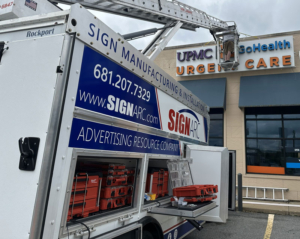
When Matt Helms entered the sign industry in 2003, he was just nineteen—young, ambitious, and operating primarily in the Charlotte, North Carolina market. Back then, installation logistics were simple: call a local sign installer, send them the job, and move on to the next project. With installers readily available, Matt had no need for bucket trucks, cranes, or specialized sign installation equipment.
But everything changed in 2016 when Matt and his wife Emily opened a new shop called SignARC of Beckley, in Beckley, West Virginia.
In their new market, Matt quickly realized something: the local pool of sign installers was extremely shallow. So, they did what most shops in that situation do: they bought a traditional bucket truck and made it work. And, for years, that truck got them by.
But eventually, their truck died and a search for an upgrade began.
Discovering a Better Bucket Truck
When Matt came across the Van Ladder videos highlighting the Chariot Bucket with its sign installation accessories, he paid close attention.
Nationwide—and especially in West Virginia—the challenge isn’t just finding workers but finding good workers. SignARC wasn’t exactly short-staffed, but they weren’t fully staffed either. They needed a way to turn what used to be two- or three-person installations into one- or two-person jobs. The Chariot Basket’s capabilities promised exactly that.
Matt’s wife wasn’t fully convinced they needed a brand-new bucket truck. Why not just buy another used truck? But there came a day when Matt’s two installers couldn’t make it to work. To keep his promise to his customer, Matt needed Emily to help install a sign. After an especially challenging installation in the hot sun where Emily suffered heatstroke, Emily asked Matt if he could’ve performed the installation by himself with the Van Ladder. When Matt said he could, Emily began leaning toward the upgrade.
Matt brought Emily to the ISA trade show to see the truck in person. After walking through the features, she agreed: this wasn’t just another truck; it was the next step in the evolution of their company. Shortly after the show, they placed the order.
Today, after more than a year of daily use, SignARC considers the Van Ladder the best investment they’ve made (not counting their amazing employees).
A Bucket Truck Replacing a Crane? Yes—Often.
Some of SignARC’s work requires setting channel letters over awnings or under large overhangs (or both). Traditionally, these installations had demanded both a bucket truck and a crane to swing the sign in place and attach it to the wall.
The Van Ladder changed that.
With the Chariot Bucket’s rotating fork system and attachable accessories, they can now lift those signs directly on the platform, eliminating the need for a crane on all but their heaviest signs.
Matt describes jobs where they once needed two vehicles and multiple workers, but now do the same work with one or two people—and only the Van Ladder on site. It has saved them labor, fuel, and setup time, especially when installing signs for a large customer with multiple locations and significant traveling time.
The Workport Storage Box: “Deceptively Big”
Besides the installation accessories, the other thing that drew Matt to the truck was the storage space.
What looked like a normal enclosure turned out to be big enough to hold a 14.5-foot sign entirely inside. With the sliding door open (between the box and the cab), the team slid the sign through, strapped it down, and kept it protected from weather, snow, and road grime.
In West Virginia winters, that alone has been a game-changer. Now they can load signs the day before an installation, leave them overnight, and arrive on-site without having to shovel off a foot of snow.
Inside the box, they customized their setup:
- Milwaukee Packout systems throughout
- Vinyl graphics supply area for quick onsite work
- A custom-built internal parts storage box
- Individual compartments for hardware, power tool, hand tools, power supplies, etc.
- A flexible “project area” for hauling signs that doubles as an indoor shop with a workbench
Matt has even prepped stud-mounted letters inside the box during rainstorms, standing up comfortably using an interior shelf as a workbench.
Attachments That Reduce Stress and Save Time
The Chariot’s tool attachments have become essential. Some favorites:
The Project Bag
Matt admits he almost removed it from the truck, thinking they’d never use it—until one day when they were installing stud-mounted letters 35 feet up. Instead of repeatedly going up and down, they loaded the bag with letters, making the job go dramatically faster.
Now the project bag is one of their most-used accessories.
The Jib Attachment
They’ve used the jib attachment on heavy, awkward sign panels that in the past would’ve required a crane. With the jib’s elevated lifting eye, they can safely bring a sign up and then level it on the wall by pulling the lifting strap right or left.
Matt estimates that for those jobs, the jib has saved:
- One additional installer
- The crane truck
- Hours of setup time
- Thousands of dollars in labor costs and fuel consumption
Plus, with one truck instead of two, they’re not monopolizing parking spaces in front of the customer’s store.
Raceways in Minutes
Mounting a raceway used to require someone holding the sign in place with white knuckles. Now, they set the platform a couple inches from the wall, resting the raceway safely, and work with hands free.
The stress is greatly reduced, and because the work is more comfortable, the installations go faster. It’s not uncommon now to have the raceway up in twenty-minutes (not counting the wiring behind the wall).
A Better Experience for Employees—And for the Business
Good tools aren’t only about efficiency—they help retain good employees. Matt’s crew tells him all the time:
“You give us the best tools in the field.”
Matt agrees. Saving one installer per job adds up more than most shop owners realize. Labor is his biggest ongoing investment—bigger than the truck itself. And anything that reduces labor without compromising quality pays for itself quickly, especially when it boosts employee morale. New installers are almost impossible to find, so you need to keep the ones you have happy.
Low Maintenance, Quiet Operation, and Outstanding Support
After more than a year on the road, SignARC’s Van Ladder has had no mechanical issues.
Their advice? After loading the truck with tools and equipment, get it aligned immediately. Once they corrected the problem of uneven tire wear, the truck has handled very well.
Matt also noted:
- The ability to work with the truck turned off reduces fumes and fuel use.
- The electric lift is quiet, especially helpful in tight areas under awnings.
- The simplified system—electric components with minimal hydraulics—is easy to work on.
- Phone support is immediate. “Never once have I got a voicemail,” Matt said.
A Milestone Moment
Among the many installs SignARC has completed, the one that stands out most to Matt is their first KFC job. Seeing their truck set signs for a national brand was a full-circle moment.
“For the 19-year-old kid who started the company,” he said, “that was the moment I thought—I made it to adulthood.”
Final Thoughts: A Bucket Truck Built for Real-World Sign Installers
SignARC didn’t just upgrade equipment—they reshaped their workflow:
- One truck replacing a bucket truck and a crane
- One or two installers doing the work that used to require three or four
- Faster jobs, safer jobs, less stress
- Weather-proof storage that protects materials and saves time
- Attachments that solve real installation challenges
- A project area that adapts to the workday
And above all, a tool that helps a growing sign company stay efficient, profitable, and proud of the work they do.

